
BEDROOM DESIGN
Bedroom design often becomes an afterthought compared to other areas of the home. However, with a bit of planning, this important space can be a room to be proud of.
function
When redesigning a bedroom, begin by identifying the purpose of the space. For example, the needs of a main bedroom will differ from those of a child's bedroom.
Main bedroom
The main bedroom, arguably, will need to function as a multi use space more than any other type of bedroom.
When considering the design of the main bedroom, the first step is to choose the biggest room available, as this space will often need to be adaptable. It's a good idea to note down the main activities the room will be used for. Apart from rest and relaxation, the main bedroom is often used as a central storage area for clothes, a dressing room, cosmetic area as well as housing entertainment equipment. The main bedroom may also need a work station, and often has an ensuite bathroom attached. Remember, the main bedroom is the one which often gets design priority, so needs to be, both practical and aesthetically pleasing.

Guest bedroom
If you have enough space for a guest bedroom, it will probably be one of the smaller rooms in the house. That being said, you will want to make your guests feel at home during their stay.
It's a good idea to prioritise practicality over style when designing a guest bedroom, including essentials such as adequate storage, and if space allows, a double bed. If the guest bedroom doesn't have an ensuite then positioning it close to the main bathroom, if possible, will be a good idea. Bear in mind, a guest bedroom that is only used occasionally can have dual functionality. For instance, the guest bedroom may double up as a work office or exercise space. It's important to avoid using a guest bedroom simply as a dumping ground, as this can be difficult to clear at short notice. Remember, when using a guest bedroom for other activities, it needs to be ready for guests at short notice.
Teenagers bedroom
Designing a bedroom specifically targeted for a teenager has it's own challenges. This is a time when this age group is developing a strong personal style, so a collaborative design approach is key.
The teenagers bedroom has various functional priorities which should be considered before considering aesthetic elements. The teenagers bedroom may also need to be a place of study as well as an entertainment area, with space for a computer, tv and games console. The fashionable conscious teenager will also need adequate storage space for clothes, as well as additional storage space to encourage tidiness. In this type of bedroom materials should be robust, such as hard flooring instead of carpet, and easy to clean blinds. Teenagers need to express themselves when it comes to choosing decorative aspects, so compromise is key.

Childrens bedroom
A typical child's bedroom ranges in age from nursery to adolescence. Like other types of bedroom, a space for the pre-teen has certain requirements.
The design of a child's bedroom will depend on age. A nursery for instance will have it's own requirements, from new born to toddler. For very young children practicality is key, such as suitable changing areas, easy to clean surfaces, safe materials and furniture etc. Like other types of bedroom, storage is also important. The children's bedroom in particular needs to be adaptable, as their requirements can quickly change. Larger beds, increased storage and essential electrical items, such as tv's and desk top computers will need to be accommodated. Therefore, think about future proofing a young child's bedroom for future changes. Choose an adequate sized room from the outset and consider the amount of electrical sockets etc. to facilitate ongoing adaptations.


MATERIALS
When determining the bedrooms function, a special mention about materials is needed. Whether thinking of furniture, flooring, textiles or light fittings, remember the type and quality of materials is important. For example, a teenagers bedroom may require a harder wearing specification than a guest bedroom. Equally a small child's bedroom needs to be a safe environment, with softer rounded materials.

LAYOUT
Plan your space !
Depending on the primary use and specific requirements of your bedroom, it's a good idea to plan the layout of your space before choosing fixtures and fittings or decorating. The easiest way to establish a layout is to draw a floor plan by utilising one of the many online space planner tools. Just input the dimensions of your room to create a scaled plan. From there, you can access furniture options allowing you to experiment with their arrangement for an optimal layout.
Traffic flow
Whether you are designing a main bedroom or child's space, remember flow is always a priority, so every aspect of the room should be easily accessible. When planning the layout, the bed is a key fundamental aspect of the room. Therefore, it's a good idea to prioritise positioning the bed on your floor plan before other fixtures and fittings. When choosing the beds location there are a few main points to keep in mind. For instance, you may want to exploit a window view from the bed or need the bed to be in close proximity of existing wall sockets. Bear in mind, in smaller rooms a single bed can be placed against a wall to save space, or even positioned above floor height to create useable space underneath. In larger rooms, the bed can be in a more prominent position, placed centrally on the main wall. This will allow matching side tables and lamps, if a more traditional aesthetic is required. If your bedroom is going to be multi-functional, for instance you may require a designated work or exercise space, you can start to zone these areas on your floor plan. Again leave enough space for adequate flow between zones and make sure lighting and electrical sockets are carefully provisioned for. Also, don't forget a place for a full length mirror, especially if you need a freestanding one.

Whatever the size of the bedroom, provision for adequate storage is a priority.

In larger spaces, traffic flow is easier to control, but be aware of overcrowding with furniture.

Smaller rooms need extra spatial consideration. This example has managed to incorporate a small work station in the corner.
Storage
Another essential aspect of the bedroom is storage, without adequate storage, the bedroom will become an untidy mess at best. Depending on the type of bedroom, and the main user, storage will differ. For example, a child will need less space for clothes and more for toys, whereas clothing storage will be a priority in the main bedroom. Remember, storage comes in many different forms, chest of drawers, shelving or even a stylish bedroom trunk all count. In smaller bedrooms, wardrobes or even a moveable clothes rail can be used to good effect. In larger spaces, consider the installation of built in wardrobes as these will maximise space to ceiling level. Remember however, to leave enough space to access whichever type of storage you choose.

BEDROOM STYLE
The style of the bedroom is of course a personal choice and should reflect your personality. However, more than other rooms, the bedroom should be a space of calm and relaxation.


When deciding on the design of your bedroom the overriding theme will be primarily driven by the function of the room, specifically, who the main user will be. Younger children's bedrooms for instance, can be styled in a more fun, whimsical fashion, whereas adolescents and older teenagers will often have their own design ideas.
A good point to realise when styling any type of bedroom, is that this is a room where you can step outside your comfort zone and use bold design elements. That said, for a more cohesive relaxed area, taking style cues from the main living space is a good place to start. Similar to other rooms, when designing the bedroom, it's a good idea to get inspiration from the architectural style of your house.
Remember, older period properties can often work well with both period or modern themes, as well as an eclectic mix. More modern estate houses and apartments are mainly suited to a modern aesthetic, though contemporary standalone properties can support a myriad of styles.
Of course, at the end of the day, styling is totally personal and ultimately, design is a subjective decision. Researching popular styles and adapting them to your own needs is also a good idea.
For example, skandi, minimalist and japandi are modern styles, whereas arts and craft, art nouveau and art deco, embrace modern and traditional elements. Other well known themes include, shabby chic, cottage, victorian and maximalist.
Furniture choice


When choosing furniture for the bedroom be open regarding the source. However, it pays to buy a good quality mattress from a reputable retailer which will aid restful sleep and last for many years. Other furniture though, can be purchased from high street retailers, online or even auctions. Bed frames, in particular, come in all different shapes and sizes, and if you are looking to add period style, such as a four poster, auctions are a great place to look. Also, if you're looking for aged side cabinets, dressing tables or even a period wardrobe, look to furniture reclamation sites as well as auctions and maybe local social media.

CHOOSING COLOUR

The colour scheme of the bedroom can have an influence on your wellbeing, especially regarding relaxation and sleep. In fact, various scientific research has tried to determine the psychological affects of differing colour with moderate success. Obviously, depending on the style of bedroom you have chosen, certain tones will be pre-determined. That being said, colour, even bold hues, can be used even in a minimalist setting to good effect. While colour is ultimately a personal choice, we get affected differently by the same colours, there are a few general guidelines which can help when deciding.
Blues and greens are associated with tranquility and relaxation, with lighter blue shades evoking calm, and grey greens being a resting colour. Neutral tones, such as whites, greys and beige are not only calming and comforting, but serve as a good backdrop for bolder colour accents. Bolder, warmer tones should be used with caution in the bedroom. Reds, oranges and yellows can look dramatic, creating a feeling of energy, but can overstimulate the senses which may cause sleep disruption. The 60-30-10 rule proposes a dominant, secondary, and accent colour mix, respectively. This rule may be helpful when bolder colours are used as the accent colour, however, you don't normally need to adhere to 60-30-10, just use as a guide. Remember, brighter hues, when used in the bedroom are best introduced as accent tones via textiles, ornaments or small sections of paint, wallpaper etc.

When introducing bolder hues, select furniture, textiles and ornamentation to add colour, avoiding over saturation.

This child's nursery shows the use of subtle pink to create a calming space. Accessories also reflect the tone.

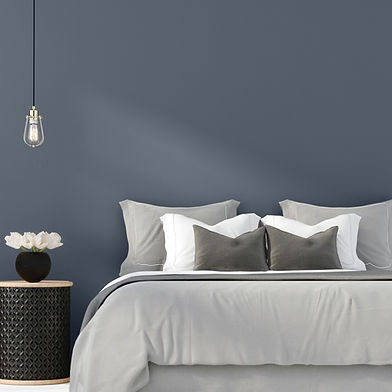
Neutral tones include a whole spectrum of colour. Here, white and grey tones contribute to a pleasing restful space.

Use accessories to add gentle splashes of a brighter colour, such as these yellow accents.
BEDROOM TEXTILES
Using textiles in the bedroom creates ambience, texture and warmth, playing a crucial role in both aesthetics and aiding quality sleep.
Textiles come in different forms, from wallpaper, throws, cushions, curtains, carpet and even furniture upholstery such as headboards. However, probably the most important bedroom textile is bed linen. A good tip is to buy the best bed linen your budget will allow, as this will pay dividends in the future.
The quality of bed linen can vary depending on the materials. As a rule of thumb, polyester is a cost effective option, but tends to be hotter in the summer and cooler in the winter. As a minimum standard, look for 100% cotton for all your bed linen. Cotton however, is also graded in quality, from cheaper brushed cotton to more luxurious Egyptian cotton with a higher thread count. Linen, which tends to be more expensive than cotton, is another good option. Though linen does take some time to soften, once it does it's very breathable and the most comfortable of all the fabrics.

A good way to add bolder colour into the bedroom is by introducing cushions or throws. Plain or patterned, they offer a further layer to the design of the room for a more ambient, embracing space. Be careful however, not to overdo it, layering a bed with an array of textiles has become popular in recent times, but using too many is impractical and looks cliched. You can also consider rugs to soften wood flooring. These can be a source of accent colour or pattern, though neutral shades are equally as effective. Remember to coordinate rugs and cushions tonally, though different textures, such as wool rugs and cotton cushions can work well.
The most popular way to dress a bedroom window is through blinds or curtains. For instance, in a more traditional or formal bedroom, heavier curtains in rich patterned fabric can look great. Whereas a more modern bedroom may suit blinds. Blinds come in many different guises, but consider fabric ones to avoid a clinical feel. Linen curtains can be a good solution for neutral modern spaces, such as skandi or japandi style. Due to low traffic, carpets are a good option for the bedroom, but avoid bold colour and pattern and use the carpet as a neutral backdrop. Buying the best quality carpet pays dividends with longevity, a pure wool with a high face weight is desirable.


LIGHTING
To create an atmospheric inviting bedroom, lighting is crucial. Room layout should make the most of natural light followed by the layering of artificial light. Beyond natural light the main sources are ambient, task and mood light.


AMBIENT LIGHT
This is the main source of artificial light in a room. Normally this will be the main ceiling lights, however, they tend to create a harsh light and in many cases just relying on task and mood lighting will be sufficient. Though it's a good idea to fit dimmers to ambient light sources, the bedroom area can effectively function primarily with task and mood lighting.
TASK LIGHT
Task lighting refers to light predominately used for practical purposes, such as reading or working. Some bedrooms may have a work space so sufficient task light will be required. Adaptable lamps make good task lights, such as an anglepoise lamp. Directional wall lights positioned over the bed are also good examples. Be careful when choosing task lights not to create a too utilitarian aesthetic.
MOOD LIGHT
Mood lighting or Accent lighting, as it's sometimes known is used to highlight certain areas of the room. This could be a feature alcove, a work of art, ornament or sculpture. Mood lighting comes in different forms, such as lamps, small directional spotlights or even wall lights. This type of light is normally soft in tone or a directional beam for highlighting objects.